![]() |
| Image Source: https://pixabay.com/en/digital-marketing-online-marketing-1527799/ |
Hunting a fly with a Bazooka. Building a skyscraper out of a molehill. Seeking humor in the modern world. A sardonic view on otherwise mundane things in life, as seen by a non-conformist. Move over Mr. Murphy, Arch is here.
Monday, September 26, 2016
Office:Office – Going digital
Tuesday, September 13, 2016
Office:Office – 40-hours-a-week
- One raised eyebrow – Really? Which world do you live in Dude? By the time I get my act together half the day is spent.
- Two raised eyebrows – Really? There are people who work only 8 hours a day? Why don’t I know any of them?
- Both eyebrows joined together in a frown – You are gnashing your teeth in anger not knowing what words to utter first. You probably need some water followed by a shot of morphine.
- Both eye brows in their place - You could be in deep concentration/ meditation to distract yourself from the reality of your 16 hour work day. Or you could have just gone to sleep (having mastered this position a long time ago)
- One eye brow lowered in a wink – Hehehe. You finally found out how I work eh? Just keep the secret to yourself and I’ll refer you to a similar opening.
Thursday, August 18, 2016
Office: Office – Maternity mindset
Thursday, May 7, 2015
Office: Office – Salary negotiation
After close to five months of a self- imposed sabbatical (it sounds cooler that way, though the truth is I had blogger’s block combined with several moments of introspection..erm.. laziness, actually), I was finally rankled enough by what I experienced recently while interviewing candidates for a role on my team. Salary negotiation.
I am aware that typing “salary negotiation” on Google can give you 50 Lakh + results (in 0.26 seconds). But no matter how many articles one reads, one will inevitably end up having a mind numbing moment when they experience any of the below tactics.
1. I am wallowing in deep shit but a rope to pull me out won’t do. I need a Jacuzzi of a life saver: An ex-colleague I knew for 3 years was desperately (at least, that’s the impression I got when she called me every few days yielding me to accelerate the hiring process) looking to move out of her current role. She fit my team’s requirement and would have received a 20% hike over her current salary, until she called to say, “You know I am 30 and don’t have a house yet. Unless I get at least 60% hike, I wont be able to buy one. I know you will consider that when you make the offer.” I was left muttering “You don’t know me very well then”.
2. I don’t care about money or designation. I only care about quality work. Of course, it will take a quality ‘me’ to produce quality work: After asking this candidates 6 timesfor her salary expectations upfront (once bitten, twice shy) and receiving the same answer, I did make an offer, only for her to reject on the grounds that it wasn’t ‘quality enough’. I discovered that quality referred to 30 paid leaves a year, free grooming sessions at a parlor, discount arrangements with five start hotels, and work related travel by business class. The pitfalls of hiring someone high maintenance haven’t been clearer.
3. I don’t know how much I want, but this doesn’t seem enough: I paused for 2 minutes when I heard this answer. And then said “Ok. I’ll come back to you,” and never did.
4. What will give me more money?: For the first time (in my 9 years of working life) I encountered a candidate who was disinterested in the role he was being offered. Instead he wanted to know what more he could do to get a ‘batter package’. “My friend does BD, Sales, HR and at times Marketing. He makes like XX Lakh. If you can offer me more than the current role and a batter package to go with it, I will close my eyes and accept.” Even if I closed my eyes, I couldn’t make such an offer.
5. Show me the money: The person in consideration went out of the consideration set, when he insisted on me depositing a part of his joining bonus, PRIOR to his taking up the offer. “I get crank calls all the time you know. How do I know this is for a genuine position?” It explained why he got only crank calls.
For those taking inspiration from these tactics. STOP. Right now. You don’t want to get featured on a blog like this.
Tuesday, December 2, 2014
Office: Office - Client relationship
Monday, July 21, 2014
Office-Office: Diversity
- The company will not be “responsible” for anything that happens to you (although they are soley responsible for empanelling the cab company to transport you).
- There is a waiting time of 1 hour before you can board the cab. Why? Traffic. What with your boss taking umpteen chai, samosa, cigarette and soo-soo breaks, forget calling a cab, you are better off sleeping in office. One problem though. The AC will be switched off and so will the lights.
- The cab charges will not be covered fully because you live too far away as per the office policy on cab reimbursements.
Wednesday, April 9, 2014
Office: Office – Employee engagement
Wednesday, February 5, 2014
Office: Office – Creativity
Friday, January 24, 2014
Office: Office – Leadership Development programme
Friday, January 10, 2014
Office: Office – Interview
Friday, January 3, 2014
Office:Office – Corporate New Year Resolution
Friday, October 18, 2013
Office: Office – Decision making
Tuesday, July 30, 2013
Office-Office : Leadership
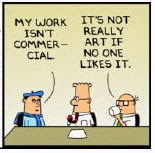
(Image Courtesy: Dilbert.com)
So, are you a leader? (of course, you are! I just asked the question again to see if you were paying attention to the post.) I have known four types of leaders in my professional experience.
a) The Superstar: This leader likes to believe the world revolves around him/her and they can’t think beyond “I”. This type hates the word “We” and chances are he/she will crush the rise of any other ‘leader’ or quit trying. More megalomaniac and less leader, the way into his good books is through ego massage. Think life size corporate standees, the company logo replaced with his initials/ signature, movie style presentations where he is the only speaker, and of course ‘unprecendented’ media coverage (even if you paid for it).
b) I am my team: Literally. This leader cannot work without his team. He mentally segregates his team into two – The professional assistants and the personal assistants. Everything from his chai to his business plan is outsourced. So what does he do himself, you ask? Well, he keeps his junta suitably enthusiastic without realizing they are actually working for him and not for the company. What rubbish! You cannot fool all of the people all of the time! That is why he always poaches his people by making them offers they cannot refuse (doubling of salaries for starters). Danny Ocean is living proof.
c) I like ‘leader’ in my designation, whether I am one or not: This is fast becoming the new norm thanks to social networking. Everyone wants to be friends with a leader, not a loser. And so, the distinction is clear – you either have ‘leader’ in your designation or you don’t. Isn’t that fooling people? Of course. But then who’s looking for reality? Would you really want to be friends with a leader if you knew what they were doing in reality?
d) The invisible leader: If you haven’t seen one yet, then you have something to look forward to. You never see this leader, only his work. You hear about his magnanimity with praise and his restraint with criticism. You see the respect and gratitude that his team has for him. Nah! It’s too good to be true. Yeah, because it takes efforts to do real work and motivate people the right way. If such a leader was everywhere, everyone would be a top performer. Even the office boy.
I have heard of other leaders too like the leader who promptly falls ill when a presentation is due in 30 minutes; or the leader who is constantly trying to jump ship when his shoddiness at work stands to be exposed; or the leader who simply prefers travelling to satisfy his wanderlust burning company money; or even the leader who prefers working from the connectivity–free zone.
So is being a leader a bad thing? Nah. How else can you get people to notice you?
Monday, May 27, 2013
IPL 6 shame gate – Do we need a cricket governance model with a bite?
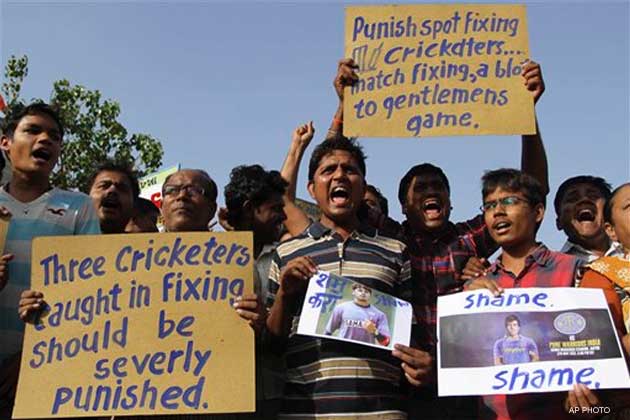
The sixth edition of the Indian Premier League (IPL) has fizzled out as fast as Pepsi’s new drink Atom (apparently it tastes like a mix of Chyavanprash and Jal Jeera with a shot of cola), thanks to the spot fixing scandal that has engulfed many IPL franchisees. This is the second time the league has been caught in such activity, the first being in 2010 that led to the ouster of Lalit Modi, then chairperson of the league. But we don’t seem to learn from the past, do we? As a nation we are used to reacting with shock/ anger at such incidents followed by apathy and amnesia. Sports governing bodies in India are no different.
(Image Courtesy - CNN IBN)
Post IPL gate (that is what the 2010 scandals were collectively referred to in the media), few provisions have been made to prevent issues like match fixing, money laundering and betting. At best, franchisees were asked to indicate their sources of funding. Knowing well that there is no mechanism to validate the information provided, it makes no sense to disclose this information. Complaints on team funding were taken up by the governing body only after court cases were filed and not suo motu.
Players are allowed to use their discretion outside of the game and one practically has no guidelines on how to conduct their lives off the field. The minute a player starts playing in a major league/ match, he leaves no stone unturned to get himself to endorse any brand that can pay him. I would assume sportspersons would like to endorse brands associated with sports like playing gear, cosmetics, shoes, permitted food supplements, apparel etc. But No. A couple of years ago four leading cricketers including the Indian’s team’s captain endorsed an alcohol brand. Is there any association between sports and alcohol? Ceiling fans, chocolates, cameras, pens, cars, fairness creams, men’s fashion, are all endorsed by sportsmen.
This brings me to a fundamental question – Do players today play for money or the love of the game? Looking at former tainted players like Ajay Jadeja and Mohammed Azharuddin, one cannot help but notice that their lifestyles today are reflective of the riches garnered during their playing days. Little wonder then that players want to grab endorsements because the money earned lets them tide through poor performance and/or scandals. They can perhaps use this money to buy a place in the team to sustain the pipeline of endorsement deals so that they have enough money to last a lifetime.
The very fact that none of this has been discussed so far is an indication that cricket’s governing body wields no real control on ethics and principles. This needs to be fixed so the game restores the dignity with which it started out in India. I feel the following measures can help.
1) Curbing the value of endorsements – Players as well as those associated with the game in any capacity (umpiring, commentary, administration etc) need to have their endorsements curbed to not exceed 20 percent of the salaries they earn from the Board. This measure would be effective in preventing gold diggers to seek places on the team. Consider this – Players over the age of 22 earn a minimum of USD 50,000 (around Rs 25 Lakh) per IPL season. Winning teams earn as much as Rs 7.5 Crore on an average and players in these teams get a minimum of Rs 15 Lakh. Add to this perks from sponsors like cars, lifetime membership/ supply of certain goods, gold etc, in recognition of performance. Most cricketers are employed by private and public sector enterprises and earn a salary, no matter how insignificant compared to the lakhs made on the field. A salary of Rs 40-50 Lakhs a year for a few months of performance is adequate to live a reasonably luxurious life by Indian standards, what with most players stretching their playing years to ten. (Marketers define luxury as having a family income upwards of Rs 20 Lakh a year).
2) Guidelines for conducting oneself off the field during a season – A night of post match partying and debauchery is a distraction from the game. It takes double the effort from the support staff to prep a player post such sessions. Little wonder then that leading sports clubs in countries like UK (football clubs Manchester United and Manchester City) and US have strict guidelines of what players can and cannot do during a game season. The list of banned activities includes partying, drugs, one night stands, wives and girlfriends, car racing/ speeding, meeting/ talking to persons not approved by the management, cell phones, and, food from unauthorized eateries, among others. Anyone caught indulging in such activity is usually not allowed to play and can be banned from the team. This is helpful for younger players who often grapple with new found fame and attention.
3) Compulsory listing for franchisees – IPL franchisees should be listed on Indian stock exchanges and 50 per cent of share holding must be with retail investors. This will accomplish two things: force franchisees to declare their funding and toe the guidelines set forth by various legislations and be governed by SEBI; create a sense of loyalty / community ownership among the public who move from being mere viewers to part owners of the franchisee. Football clubs in the UK follow this model where franchisees are usually homegrown and hence enjoy loyalty from the communities. Considering IPL does not endorse that model, there is less loyalty between franchisees and the crowd. What complicates matters is that in many cases neither players not franchisee owners belong to the cities where these franchisees are based.
Cricket in India has long been a club of sorts run by patrons. The BCCI follows this archaic model where members are often heirs of the erstwhile patrons or political appointees, aspiring for control. But today the game has outgrown itself and taking strong measures can help run it professionally with dignity.
Monday, May 6, 2013
Office-Office: Resignation
(Image courtesy: www.Dilbert.com)
Once you throw in the towel, you have pretty much said ENOUGH. Instead of congratulating you on this monumental effort at your sanity preservation, people grow hostile. Some with a vivid imagination propagate the grape vine that you are joining the competition, when all you are doing is realizing you will be penniless for the next three months (did you expect they would pay you a salary during your notice period? You need to be shot for your naiveté!).
Why do people do this? I have three theories.
1. They are jealous – Because you kicked the system in the gut and are supposedly moving on to a better place. They too want to move on to this better place but don’t have the gumption to repeat your act.
2. They are bored and need a career change but then, no one wants to hire them – Perhaps they want to become fiction writers. Of the torrid romance variety, replete with love, sex, dhoka and glycerin tears. They are just using your situation to see if the novel can be based on you. This is creative license, not malevolence, they will claim when confronted.
3. They are afraid – Surf’s out and you caught them without their pants. Your leaving spells doom because they would actually have to work now. No more forwarding your work as theirs, which means they need to know how to animate slides and how to change the font size and color and aligning textboxes and inserting pictures and providing the content for the deck as well. They don’t have a choice but to work fast towards getting your replacement. Imagine doing all that work themselves!.
4. They are angry – This is technically not an original theory but it could be an outcome of any of the three theories above. In a rare occasion this theory could prove to be original - when you may have, in drunken stupor or plain childish enthusiasm, agreed to a pact with some fellow co-workers saying “we’ll all quit together.” Now, you’ve quit and they haven’t. And they are coming at you with that beer bottle to fulfill their side of the deal.
Ok. Now what? Well, best to be armed with a good answer for every attempt the management makes to keep you on board (assuming they actually care for you). While serving notice period at least you can dream of walking in the greener pastures of the future. If you take back your resignation, you won’t have the time to dream.
Tuesday, April 9, 2013
The retro connection - Norah Ephron and our lives
Norah Ephron’s I feel bad about my neck and other thoughts on being a woman isn’t what I would call my ideal read. Hell no. After all, who wants to read about one’s obsession with one’s neck? So after parking this book for a week on my desktop, I finally managed to read it. For those who did not know (and that included me before I read the last page of the book), Norah Ephron wrote the screenplays for some of the films I like - When Harry Met Sally, Sleepless in Seattle, and You’ve Got Mail.
What I discovered in her memoirs was profound.
The book details Norah’s experiences in the 1950s, 60s and 70s. Forty years on, there is a strange sense of déjà vu as many of my friends seem to be experiencing life the way she did.
1. The obsession with foreign/ exotic cooking: Norah’s obsession (and probably that of other women in that era) with French cooking is reflective of India’s current obsession with cooking Italian food and baking. The rising number Nigella Lawson and Master Chef Australia fans, plus the rising TRPs of food shows is testament to this. I find some of my friends cooking seven course meals for friends “who just dropped by.” Seeing them I am tempted to throw in the towel right away and settle for the good old curd rice. Just like Norah settling with the Lee Bailey style of cooking – whatever one is comfortable with.
2. Maintenance woes: I am not talking about the money that we shell out every month to ensure that running water, power backed up electricity and clean corridors are a reality in our apartment complexes. I am talking about personal grooming and care (what most husbands will call “waste of time” or “Shoo-shah”). It makes me mad that I don’t look like the Fair n Lovely before and after images whenever I am done with whatever I do. Blame it on outsourcing, cheap prices, and plain laziness. I think our mothers did good with their use of homemade beauty products and no, they did not know about manicure.
In recent times the only youngish woman who I have seen with less than perfect hands is my domestic help (apart from me that is). Even my baby sitter has a 30 minute routine every Saturday morning for doing up her nails. I am dreading the day my two year old daughter asks me to do up hers. No, it’s not the money and time that will be spent on this. I just don’t know how to do them!
3. Renting houses: Norah rationalizes her whopping rental amount as “the price paid for one cappuccino every day for 10 years.” We do it by saying “it’s only half my salary and I need I decent place to live.” An acquaintance recently bought a 3300 sqft house from an upmarket builder for at least Rs 3 Crores. I don’t know what her rationale could have possibly been, but I don’t have the heart to tell her that she won’t be able to clean the house when the maid won’t show up. Perhaps it’s better to live amidst filth, especially if there is 3300 sqft of it. I will never know.
There are many other parallels one can draw from the book but this is not a book review. What amazes me is that our lives are no different from those of people a few decades ago, despite the whole lot of advancements that have come our way. It signifies that the human spirit is indomitable and irrespective of socio-economic-cultural statuses our desires are similar.
Friday, March 1, 2013
Moving away from populist politics
Narendra Modi has faced considerable criticism of his leadership and vision (or the supposed lack of one), in recent times. (He is likely to contest for the Prime Minister’s post in the 2014 elections). While Justice Katju’s is the most vitriolic criticism of the lot, other critiques have predictably focused on issues such as education and health standards in the state and of course, the marginalization of muslims. Modi’s defenders have been quick to point fingers at the Congress lead UPA government’s misdeeds in its reign. Media has given ample space for this war of words and at times has even taken sides. In this melee, what no one seems to have highlighted is a fundamental shift in the way Indian politics is likely to play out in the near future - with possibly Modi at the forefront (Modi, because I have not heard of anyone else working on this model in their constituencies/states).
For a country whose political class has long survived in power doling out subsidies and freebies by the dozen, Modi’s transformation of Gujarat seems unbelievable and even threatening. For he has managed to match (and outgrow) most states on many parameters with little subsidy or freebies. Given our burgeoning fiscal deficit, India has little option but to stop giving freebies sooner or later. (If India were a company, it would be shut down even before it started doing business, is what one chartered accountant friend told me). But to do that, one needs to create a culture where people want to work towards their sustenance and freebies and other entitlements are looked upon as charity and not one’s birth right. How do you do that?
Through needs assessment. In marketing parlance, needs assessment refers to understanding customer aspirations. This can further be broken down into stated needs, real needs, unstated need, delight need, secret need etc. Let us apply this to the existing set of voter aspirations in a relatively under developed state. Assuming the voter is a man aged 30-35, these are roughly what his needs could be.
• Stated need – More income (possibly to buy TV/ fridge/ car and other items)
• Real need – Better/ additional opportunities for employment and wealth creation
• Unstated need – A steady source of income that helps beat inflation to some extent and allows him to save money
• Delight need – Infrastructure provided by the government to support him in achieving this objective. Eg: assuring public safety, better transportation, emergency healthcare support, skills up-gradation through subsidized programmes and courses etc.
• Secret need - To be respected by his family/ community as a successful/ prosperous individual who has not employed dubious means for growth.
I am aware that it is not that simple to segregate voters and their needs, but that is what political think tanks and governments should be doing. A poor man cares less for religion and politics and more for his next meal. But what he will respect a political leader/ state for is providing him a with a means to earn that meal. This is perhaps the reason why Nitish Kumar has been more successful than most other Chief Ministers of Bihar.
An economy that grows through job creation is less volatile than one that runs on freebies. Such an economy is also able to ensure relatively equitable distribution of wealth among its people over time. Developed countries around the world follow this principle of limited subsidy and reservation, allowing them to bounce back from adverse economic conditions. The US offered dole money of $1000 a month for upto 18 months to citizens who had lost jobs during the recession. After 18 months, not a penny more was offered and those who lived off the money without looking for jobs had to fend for themselves in the job market. In Europe, everyone earning an income (irrespective of the income level, age, religion or community) is taxed and in return many facilities such as healthcare and education are subsidized heavily. Technically, you still have to contribute something to become eligible for a range of government provided subsidies.
Narendra Modi is subtly trying to encourage such a model to enable growth. Perhaps we should give this model a chance. After all, Robinhood economics has not benefittted the country in the last 60 years that it has been subtly practiced.